I often critique other traders and investors on the collective2 platform. Since this is done via the interenet it rarely results in them actually listening. But I hope you listen. If you disagree show me why I’m wrong in the data below.
In that post they state the rules of the system, but do the rules work in backtests? I don’t think so.
Below are the basics quoted from the blog post they made.
Price above the 200 SMA? You only take longs, my friend. That’s your direction. If it’s below, you’re looking at shorts. No flip-flopping here — stick to your lane.
Market opens above the 9 EMA? Well, that’s your signal to go long, cowboy.
Stops and targets are determined by the ATR (14). You’ll set your stop loss at 2 ATR and aim for a profit target of 3 ATR. Not complicated math here, just risk and reward — served up plain.
My Backtesting Results
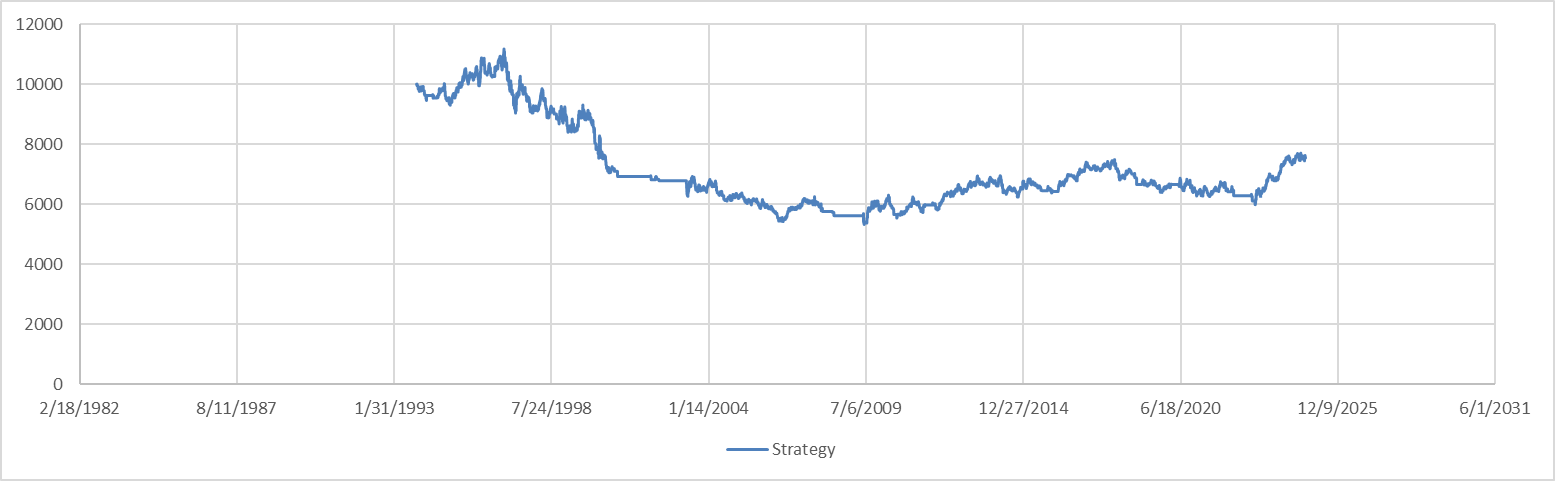
I used daily SPY data from Tradingview to run my calcs. I calculated the SMA, EMA, and ATR at the close of each day. Then at open on the next day I checked if the buy criteria were met. If so the strategy entered at the open and held until close unless the profit target or stop loss was triggered. Because I was using simple daily Open, High, Low, Close data I couldn’t determine easily if the high or the low of the day occurred first on days when both the stop and profit target were hit. So I ran the backtest with the generous though not realistic approach of assuming the profit target would have been hit first on days where both were hit.
The results….not great.
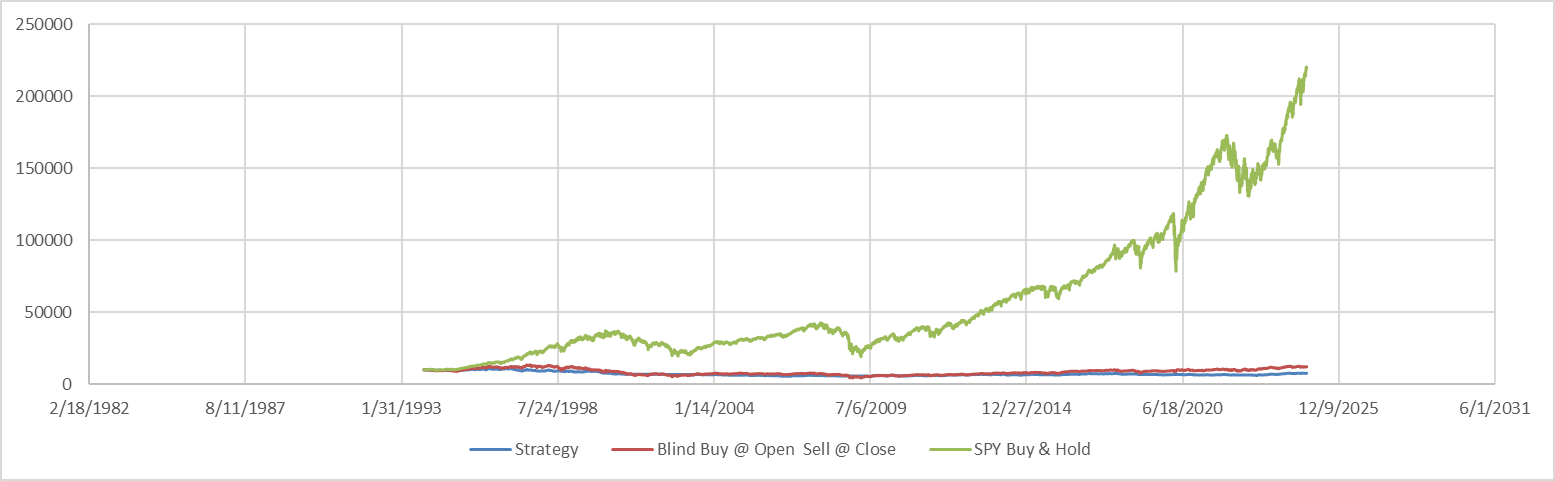
The main reason this strategy did poorly is because it doesn’t hold overnight. Take a look at this overlay of a blind buy at open and sell at close. Notice its quite similar.
Many traders don’t realize how much overnight returns tend to contribute to total returns.
Perhaps Sean knows something that I have missed, but at first glance this doesn’t look like a winning strategy to me. But I had fun fact checking it. Do you want to fact check me? Well download this excel sheet and check it.
This is not investment advice for you. This website is designed to talk about investments but it is not designed to give you personalized investment advice. This site contains generic information that does not have the capability of taking your personal risk tolerance, goals, assets, or other factors into account. Therefore, this site and all of its related content is for entertainment, informational, and educational purposes only.
The owner of PatienceToInvest.com is also a trade leader on Collective2.com. We may receive compensation by promoting some collective2 strategies over others. Should you decide to make or avoid any investments or use any service due to the information on this site or related information you assume full responsibility and risks and will not hold howiinvest.com it’s associated sites or its owners responsible. You also acknowledge investing is risky and can result in the loss of all your capital and even more than your original capital in some cases.
Focusing on methodology and investment philosophy is crucial when considering a strategy or a switch in investment. Recent performance, whether good or bad, doesn’t always reflect the long-term viability of a strategy. It is concerning when a provider claims something like they plan on consistent x% monthly return; such promises often fall short of reality in the complex world of trading.
My investment strategies, such as “Easiest” and “Patience is a Virtue,” embody a pragmatic understanding of the financial markets, grounded in the fundamental truth that in the world of investing, there are no guaranteed wins every year. Anyone promising otherwise is likely overselling or deluding themselves.
My approach acknowledges the inherent trade-off between risk and reward. Seeking higher returns inevitably involves embracing higher levels of risk. This requires the acceptance of higher drawdowns.
If you are still making the correct trades but experience drawdowns, they are not indicative of failure. Rather they are an inherent part of the investment journey. They are the price paid for the pursuit of potentially greater returns over the long term. While it’s possible to navigate and mitigate drawdowns to some extent, they cannot be entirely eliminated. They must be embraced and prepared for.
By adopting a mindset that embraces the reality of drawdowns, you’re better positioned to weather the storms of market volatility. Rather than being caught off guard or disillusioned by downturns, you’re prepared to stay the course, recognizing them as temporary setbacks within the broader context of your investment horizon.
In the pursuit of higher returns, it’s crucial to maintain a realistic perspective and remain committed to your investment philosophy, even in the face of temporary setbacks. This steadfast approach, grounded in the recognition of both the ups and downs of the market, lays the foundation for sustainable growth and long-term success.
Absolutely, believing in the investment thesis is paramount to successfully weathering drawdowns and staying committed to your strategy. Your thesis should reflect a comprehensive understanding of various asset classes and their potential for positive returns over the long term. An investment thesis should not involve the following:
XYZ went up last year/month/week. So I will buy it!
ABC went down last year/month/week. So I will sell it!
I believe there the next 20 years has great growth potential across equities, bonds, crypto, precious metals, and short volatility instruments. That is why I trade all these markets. This broad diversification allows me to capture opportunities across different sectors and asset types while managing risk through a well-rounded portfolio.
Taking it a step further down the risk rabbit hole, the best returns will likely be those that leverage their portfolios 2 or 3 times if they can remain solvent. This means using diversification, trend following, limited-loss leverage methods, and a healthy dose of patience.
Likewise, it will require rarely going against these markets. Frequently betting against the markets makes it so much harder to succeed in the long run. Your investment decisions should be rooted in a rational assessment of market dynamics, maximizing your chances of success over the long haul. Investment choices should never be made based on what went up last year and what went down.
This is not investment advice for you. This website is designed to talk about investments but it is not designed to give you personalized investment advice. This site contains generic information that does not have the capability of taking your personal risk tolerance, goals, assets, or other factors into account. Therefore, this site and all of its related content is for entertainment, informational, and educational purposes only.
The owner of PatienceToInvest.com is also a trade leader on Collective2.com. We may receive compensation by promoting some collective2 strategies over others. Should you decide to make or avoid any investments or use any service due to the information on this site or related information you assume full responsibility and risks and will not hold howiinvest.com it’s associated sites or its owners responsible. You also acknowledge investing is risky and can result in the loss of all your capital and even more than your original capital in some cases.
Whatever strategy is number 1 on Collective2 won’t stay that way. It never does. Let’s talk about why! The current number one strategy on Collective2 is about 16 months old. Not too long ago it popped into the number one spot. It currently has an annualized return of 133% and max drawdown of only 26.6%. That is awesome! Kudos to BlackBoulderTrading! But this strategy won’t stay number 1. Sorry.
Let’s take a look at some previous examples. Starting with my own.
Patience is a Virtue
Believe it or not my strategy Patience is a Virtue / How I Invest 1 OG was once upon a time the number one strategy. It had an annualized return of 189% in 2020 and a max drawdown of about 19%. It was doing amazing.
But fast forward from then to now and it hasn’t done nearly as well.
AI TQQQ SQQQ
Fortunately, I am not alone, this strategy by QuantTiger who seems to be a nice and reasonable person was also number one and for good reason. It had a return of about 274% with a max drawdown of less than 30%. Holy moly! Notice that is by far the best of the three discussed so far.
But carry forward from then to now it hasn’t done nearly as well.
But fast forward from there and we see that it was a catastrophe going forward.
The Problems
Past returns are not indicative of future returns. Investors need to stop writing this off as just some legal disclaimer. It is the cold hard truth! Beat it into your brain!
No one is a fortune teller. Assuming no one is cheating, no one can predict fair coinflips over and over again at a rate better than 50%. They can’t! They may get it right the first time and start with a 100% success rate. They may even get the first 4 right and look like a genius. However, overtime their accuracy will continue to approach 50%. Likewise, If this year 100 new strategies start on collective2 using high levels of leverage and 100 different combinations of signals, assets, etc. at the end of two years by pure chance some of them are going to be crushing the market!
Return Chasing: Investors underperform benchmarks because they return chase by buying whatever is recently popular and sell whatever has dropped in value recently. This leads to higher costs and often means buying high not low.
These are problems all investors face. The main difference between investors on C2 compared to a typical brokerage house is that C2 has higher risk strategies to pick from. So these problems get amplified. Those that are lucky have over 100% portfolio returns and those that are unlucky have 100% drawdowns etc. Sorry those of us that are lucky enough to get a 100% return year aren’t geniuses.
The Solution
I believe it is possible to do better than a typical stock mutual fund on C2 with a small tweak. Accept the following
No one knows the future.
No strategy is going to appear and double their investments every year for the next 8-10 years despite people saying “my hope is to get 1 double per year.”
To have higher returns you must take on more risk, or get lucky.
I believe that using makes it possible to beat the market. Maybe instead of a 10% annualized with the S&P 500 a high risk investor with 3X leverage could get in the ballpark of 15% to 40% annualized for a decade. But this is very high risk! To mitigate some of the risk diversifying, reducing costs, good risk management, trend following, and other risk mitigation techniques may help make the drawdowns recoverable. Instead of a 90% drawdown from 3X leverage during 2008 maybe it is a only a 50% drawdown in 2022 because bonds and stocks dropped with rising interest rates etc. This is something I think is possible though far from guaranteed. However, getting 100% a year and not having a drawdown of 75% plus just isn’t going to happen over the course of decades. One of the two is going to break down.
How to Avoid Disaster C2
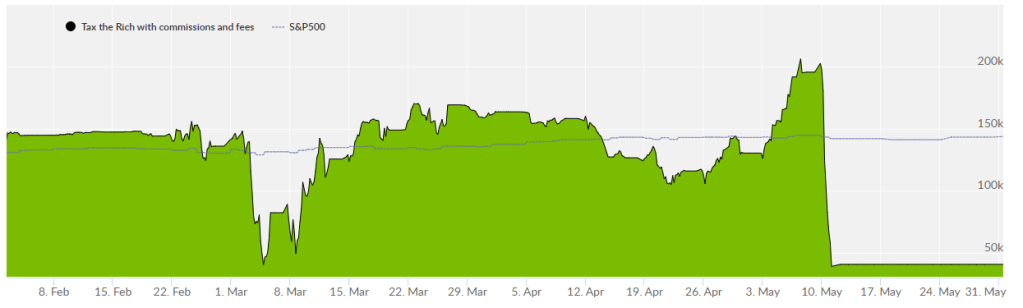
Furthermore I wouldn’t just pick any C2 Strategy. I would pick ones that fall within certain risk tolerance limits and that align with the philosophy I have just laid out. So the first thing I would check is whether or not the leader agrees that it is pretty much impossible to obtain higher rates of return without taking on higher levels of risk. They may talk about it in their description or their blogs, forums etc. (Like me!) Then I would make sure nothing fishy is going on and that the leaders are not taking on too much risk as shown in the images below. This can be the difference between a bad year and a negative 80% year!
Let me clarify that I don’t totally disregard non auto trades or data, but I’m more skeptical of it especially with less liquid instruments.
MY Thoughts on the LeaderboardS
I also pretty much ignore the popularity leaderboard unless C2 changes the formula. I instead tend to mostly consider strategies in the category of stocks long-only/IRA friendly as this means you inherently have some risk measures in place. In fact, I did a forward test that lasted for almost 3 years where I rebalanced every so often into the top 15 strategies in different leaderboard categories. This table shows the results. As you can see the IRA board was the only one that beat the S&P500.
Unpopular opinion: the IRS is saving your booty by not letting you use 15X leverage with futures in your IRA.
In that screenshot you can see that I actually currently subscribe to Leveraged ETF Trading though I don’t AutoTrade it like I trade my own. I subscribed because it was cheap and I wanted to follow along live and get the email messages. However, I am still not comfortable enough to tie my own real money to the number 1 strategy.
You may also notice that my strategy How I Invest 2 IRA is currently the number 2 strategy on both the popularity and the IRA leaderboard. But as I have said it won’t stay there. It will have bad periods. This strategy How I Invest 2 is actually the same strategy as How I Invest 1 with mostly minor changes and just a different start date. But you can see that it is very popular right now because it is younger and only covers the period of recent good performance – which doesn’t tell you how well it will do next year! Below you can see an image of both strategies How I Invest 1 and 2 over the same time period. Notice how the NLV curves look the same if you zoom 1 into the same period that 2 existed.
I want to follow a trader that understands they can’t predict the future, they can’t beat massive trading institutions at their own game, previous drawdowns aren’t a good indicator of risk (particularly with short time periods on C2), and no 100% per year strategy is going to last on C2 as a 100% per year strategy. For myself I am that trader.
Market Inefficiencies Don’t Last
Sure I may be better at trading than Joe Shmoe, but for the most part that isn’t who you or I are competing against. We are competing against institutions that are massive and have huge resources in regards to money, people, technology etc. Likewise they are competing against each other too. If someone does find an inefficiency in the market they either take advantage of it until it is eroded, or the cat gets out of the bag and lots of people do it till it is eroded. Even people that are good run out of room to be good. Warren Buffett and Peter Lynch are great business analysist. But when you start to manage so much money that you are the market it becomes hard to beat it with any real significance. Had Peter Lynch stayed in the game long enough he likely would have had the same experience.
This quote from Sapiens touches on the point
“History cannot be explained deterministically and it cannot be predicted because it is chaotic. So many forces are at work and their interactions are so complex that extremely small variations in the strength of the forces and the way they interact produce huge differences in outcomes. Not only that, but history is what is called a ‘level two’ chaotic system. Chaotic systems come in two shapes. Level one chaos is chaos that does not react to predictions about it. The weather, for example, is a level one chaotic system. Though it is influenced by myriad factors, we can build computer models that take more and more of them into consideration, and produce better and better weather forecasts. Level two chaos is chaos that reacts to predictions about it, and therefore can never be predicted accurately. Markets, for example, are a level two chaotic system. What will happen if we develop a computer program that forecasts with 100 per cent accuracy the price of oil tomorrow? The price of oil will immediately react to the forecast, which would consequently fail to materialize. If the current price of oil is $90 a barrel, and the infallible computer program predicts that tomorrow it will be $100, traders will rush to buy oil so that they can profit from the predicted price rise. As a result, the price will shoot up to $100 a barrel today rather than tomorrow. Then what will happen tomorrow? Nobody knows.”
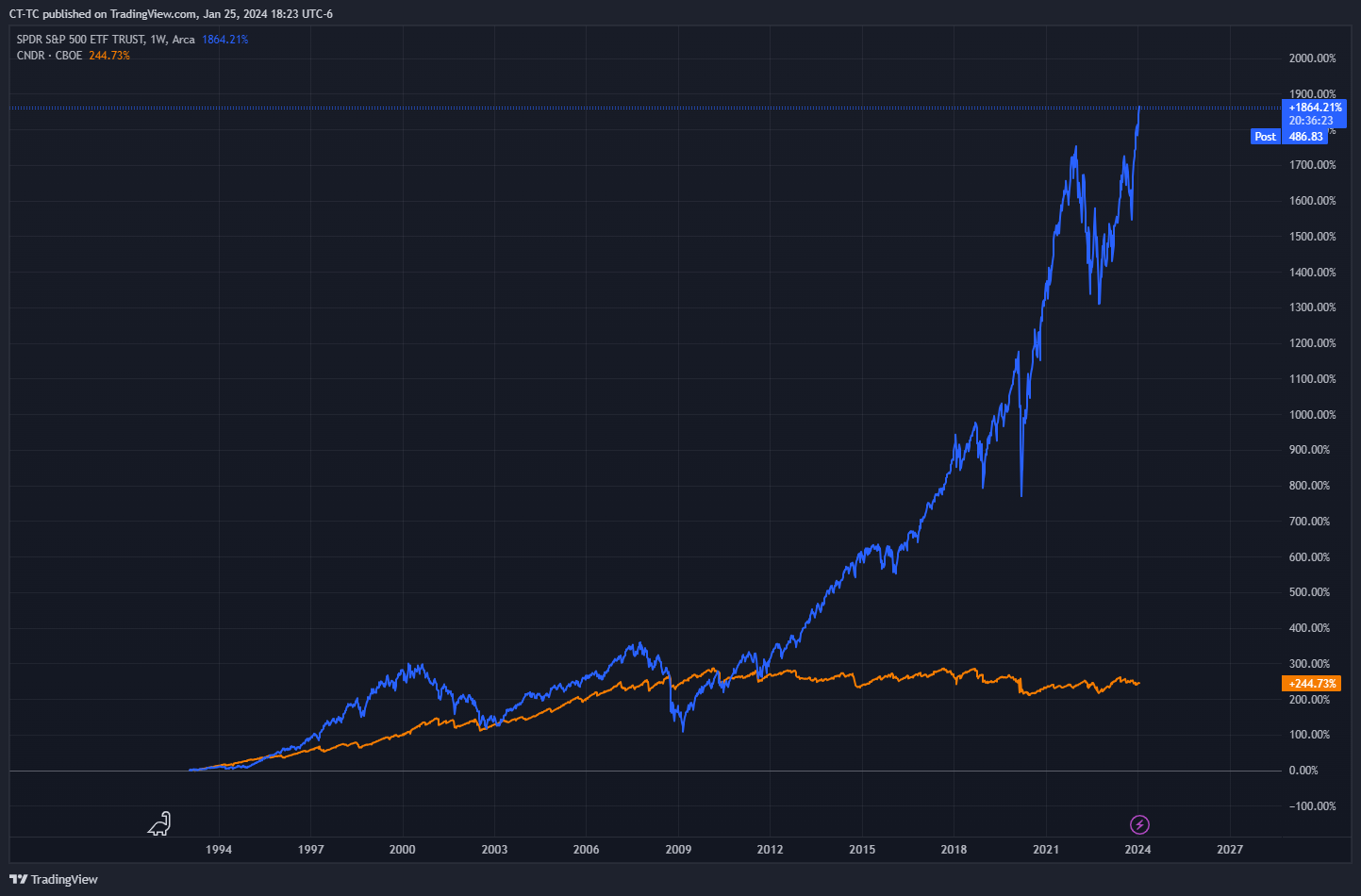
I’m not saying there aren’t inefficiencies. I’m saying we don’t know what they are. There are a million and one ways that people try to make you think there is an obvious inefficiency they can exploit by selling puts, covered calls, iron condors, trend following, leverage, etc. These are just different way to package risk. Go look at the iron condor index (CNDR) or a covered call ETF versus the SPY or balanced fund. These are just different and often more expensive ways to package risk.
Follow What You Want
So by all means subscribe to whatever strategies you want on C2 and use whatever methodology you want. That is the beauty of C2. But IMHO you must accept the reality that it isn’t going to be a smooth ride, no matter how good someone’s performance has been. Likewise it is hard to distinguish between luck and skill. Accepting these tips may be the difference between actually benefitting from collective2 (as a subscriber) or just losing to the indexes like every other trader.
I have nothing against any of the strategies mentioned here. I realize this post may come off as though I think I know it all. I don’t! There are plenty of better investors than me, but I do think they would agree you can’t beat the market without taking on more risk – whether that comes from leverage, higher beta, or more concentration.
This is not investment advice for you. This website is designed to talk about investments but it is not designed to give you personalized investment advice. This site contains generic information that does not have the capability of taking your personal risk tolerance, goals, assets, or other factors into account. Therefore, this site and all of its related content is for entertainment, informational, and educational purposes only.
The owner of PatienceToInvest.com is also a trade leader on Collective2.com. We may receive compensation by promoting some collective2 strategies over others. Should you decide to make or avoid any investments or use any service due to the information on this site or related information you assume full responsibility and risks and will not hold howiinvest.com it’s associated sites or its owners responsible. You also acknowledge investing is risky and can result in the loss of all your capital and even more than your original capital in some cases.
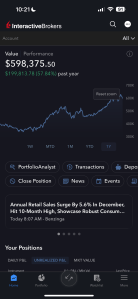
Days like today can be stressful. After hitting a high of $631,754 in my personal IBKR accounts six days ago, they are down to $595,848 in a string of three losing days. That is an average daily loss of $12,000 or 1.9% a day about three times worse than the market!
The desire to jump out can be high in moments like this. After all I have had such a good run since September when the accounts were at just $461,000 as shown in the image below. But it is important to ignore this impulse to trade based on recent return. It is better to only sell when the algorithms have a trigger.
This persistent myth and desire of high returns with low volatility does great damage to a our ability to obtain either. Over and over again it is shown that active traders, hedge funds, and professionals are not good at beating a simple index fund strategy. So why should I bother trading?
It is my view that to beat a market you must take on more risk than said market. If I want to beat the long-term total return of 0-3 month treasury bills the worst way is to go buy individual 0-3 month treasury bills. The best way statistically is to go invest my money in a higher risk asset assuming I am willing to accept higher volatility and remain invested longer.
In regards to the stock market one can do this by buying stocks with higher betas, purchasing options, using leverage via futures, leveraged etfs, margin loans, etc. These are all ways to take on more risk and have different pros and cons. One can try beating the market with stock picking but any success is likely due to luck or holding a higher average beta portfolio.
Generally I think technical analysis is unable to give you higher rates of return in the long run all else and in particular beta being equal. If you trade only SPY there is little chance that after taxes and fees you will be able to beat SPY total returns over a decade. However, if you trade UPRO (3X SPY) and use some risk mitigation techniques I think you can beat SPY in terms of total returns, but regardless of what your max draw down is you most certainly took more risk. Just because something worked out doesn’t mean you didn’t take more risk.
It is best to accept that it is impossible to predict what the next days market result will be. How ridiculous would I be if I thought I could predict the outcomes of a fair dice roll beyond the prophecies of statistics. How arrogant would I have to be to think I could predict the market better than the millions of professionals with billions of dollars under management.
This is why I believe it is best to mostly remain invested and just absorb the 3% down days etc. However, this doesn’t mean no trading should occur! There are two main reasons to make a trade.
Better Opportunity: If we are in stocks but according to the historical statistics bonds offer a better average daily return under x,y,z metrics then it is best to sell some stocks and buy some bonds.
Elevated Portfolio or Market Risk: Imagine you play a game where every correct coin flip you get a dollar and every wrong one you lose 50 cents. If your money hits zero you are done. If you start playing this game with $100 in reserve it is an easy money maker. If you start playing with only $1 it would be pretty easy to lose. Sometimes the risk can be too high because of market conditions. Sometimes the risk can be too high due to portfolio positions. Likewise if I were using $100 but the games metrics changed to earn $10 or lose $9 it may be best to take a pause.
My algorithms are getting closer and closer to having some sell signals for some of the portfolios, but I am not going to exit just because I had a 6% drawdown while using 3X ETFs. This is to be expected.
This is not investment advice for you. This website is designed to talk about investments but it is not designed to give you personalized investment advice. This site contains generic information that does not have the capability of taking your personal risk tolerance, goals, assets, or other factors into account. Therefore, this site and all of its related content is for entertainment, informational, and educational purposes only.
The owner of PatienceToInvest.com is also a trade leader on Collective2.com. We may receive compensation by promoting some collective2 strategies over others. Should you decide to make or avoid any investments or use any service due to the information on this site or related information you assume full responsibility and risks and will not hold howiinvest.com it’s associated sites or its owners responsible. You also acknowledge investing is risky and can result in the loss of all your capital and even more than your original capital in some cases.
I wanted to verify how collective2 handles stop orders for positions that may have already exited or stops for quantities that are greater than the current position. To test this I opened 2 shares of VXX and placed several sets of stops for 2 shares. Then I closed one share and waited to see what would happen.






 How I Invest